
James Harrison, Australia’s Famous Blood Donor Who Saved 2.4 million Babies, Dies at 88

James Harrison, Australia’s Famous Blood Donor Who Saved 2.4 million Babies, Dies at 88. James Harrison, one of the world’s most influential blood donors, passed away at the age of 88 in Australia. Known as the ‘Man with the Golden Arm’, Harrison’s plasma donations are credited with saving the lives of 2.4 million newborn babies. His blood contained a rare antibody called Anti-D, which is used to create a special medication administered to pregnant women whose blood could potentially harm their unborn babies.


According to reports, it is impossible to estimate how many infant deaths occurred before the Anti-D treatment was available. However, government data shows that Hemolytic Disease of the Fetus and Newborn (HDFN) affected 1 in every 100 pregnancies until 1966. Around 17% of pregnant women need the Anti-D injection, but finding donors for the program remains a difficult task.

Pledged to Donate Blood After Surgery

The Australian Red Cross Blood Service ‘Lifeblood’ paid tribute to Harrison, recalling how he pledged to become a blood donor after undergoing major chest surgery at the age of 14, during which he received a life-saving blood transfusion. He started donating blood at 18 and continued every two weeks until the age of 81. In 2005, Harrison set the Guinness World Record for the most blood plasma donations, a record he held until 2022.
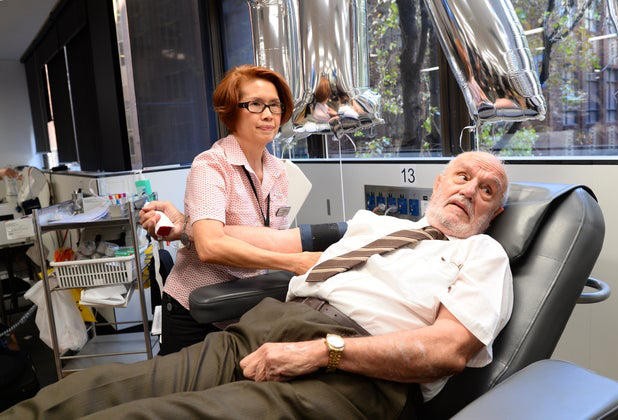
James Harrison
‘Man with the Golden Arm’, Harrison’s plasma saved lives of 2.4 million newborn babies.

Harrison’s daughter, Tracy Melloship, said her father was proud to have saved millions of lives without any pain or cost. “Dad always said that blood donation is painless, and everyone should do it,” she said. Interestingly, Harrison’s two grandchildren also received the Anti-D injection made possible by their grandfather’s plasma.

It remains unclear how Harrison’s body produced such high levels of Anti-D. Some reports suggest that his rare antibodies may have developed after receiving a blood transfusion during his surgery at 14.

Only 200 Anti-D Donors in Australia

Currently, there are only 200 Anti-D blood donors in Australia, helping protect around 45,000 pregnant women and their babies every year. The Lifeblood service and the Walter and Eliza Hall Institute of Medical Research are working together to develop synthetic Anti-D antibodies in laboratories, but natural donors like Harrison remain extremely rare.
Hot this week

Preventable Hypertension Complications Endanger Mothers and Newborns: Study Finds

Hypertensive disorders of Pregnancy (HDP) continue to be a major threat to maternal and neonatal health, particularly in developing countries like India. A recent study conducted at Cama and Albless Hospital, a tertiary care teaching hospital in Mumbai, highlights the clinical profile and outcomes of pregnant women affected by pregnancy-related hypertension.

Maternal Health Crisis in the U.S. Puts Infants at Higher Risk, New Study Finds

Improving women’s health is vital not only for mothers...

Two in Three Women Have Preventable Risk Factors for Birth Defects, Study Finds

According to the researchers, these factors can disrupt one-carbon...

Study Finds Toxic Lead and Uranium in Children’s Blood in Punjab and Chandigarh

Toxic metals like lead and uranium in children’s blood...

Gynaecologists to Use AI for Reducing Maternal Mortality in India

Maternal and childcare is one of India’s key health...

Topics

Preventable Hypertension Complications Endanger Mothers and Newborns: Study Finds

Hypertensive disorders of Pregnancy (HDP) continue to be a major threat to maternal and neonatal health, particularly in developing countries like India. A recent study conducted at Cama and Albless Hospital, a tertiary care teaching hospital in Mumbai, highlights the clinical profile and outcomes of pregnant women affected by pregnancy-related hypertension.

Maternal Health Crisis in the U.S. Puts Infants at Higher Risk, New Study Finds

Improving women’s health is vital not only for mothers...

Two in Three Women Have Preventable Risk Factors for Birth Defects, Study Finds

According to the researchers, these factors can disrupt one-carbon...

Study Finds Toxic Lead and Uranium in Children’s Blood in Punjab and Chandigarh

Toxic metals like lead and uranium in children’s blood...

Gynaecologists to Use AI for Reducing Maternal Mortality in India

Maternal and childcare is one of India’s key health...

Only 4% of Young Indian Women Exercise Daily, Survey Reveals

Only 3.9% of young women aged 15-29 exercise daily,...

Beyond the Glamour: Celebrities Share Emotional Struggles During Childbirth

Their stories shed light on the hidden struggles of...

UNICEF’s Call to Action: Tackling the Rising Burden of NCDs in Children and Adolescents

Unlike infectious diseases, NCDs are not passed from person...

Related Articles

Translate »