



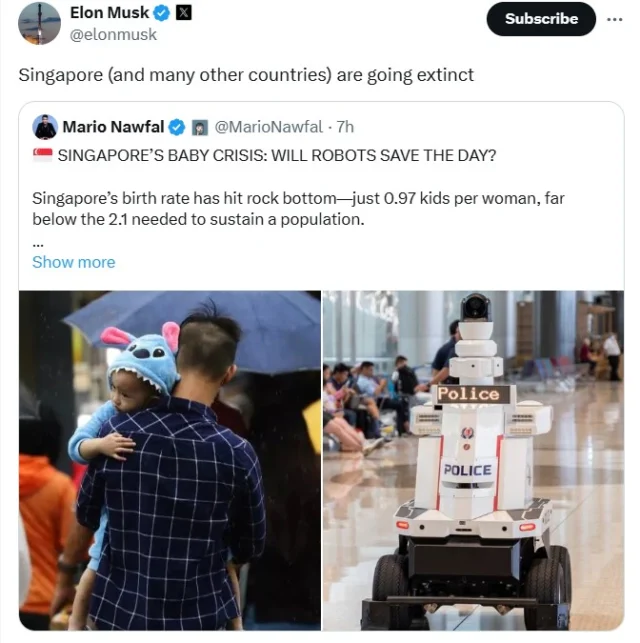
Many countries around the world are struggling with the issue of population decline. Speaking of Singapore, the situation there is becoming increasingly serious. The fertility rate in Singapore has fallen to 0.97, which is significantly lower than the 2.1 fertility rate needed to maintain population balance. China, Hong Kong, Japan, and South Korea have all seen a similar trend. India is also on an equally concerning path.
Elon Musk said “Singapore will be extinct”
Highlighting this issue, Tesla and SpaceX CEO Elon Musk recently tweeted about the declining fertility rates and aging populations in several Asian nations. Responding to an article on Singapore’s “baby crisis,” Musk wrote on X, “Singapore (and many other countries) will be extinct.” Known for advocating higher birth rates to avert a global population collapse, Musk’s statement underscores the urgency of this growing problem.
The world’s fertility rate has decreased by 50% in 70 years
In the past 70 years, the world’s fertility rate has declined by 50%. Notably, until the 1970s, countries like South Korea, Japan, and China had an average of more than five children per woman. However, now in these countries, the average number of children per woman is less than one. Over the past 50 years, the global fertility rate has seen a 50% decline. Experts have warned that South Korea’s population could be reduced to half by 2100 if the trend continues.
Singapore turns to ROBOTS to deal with crisis
Faced with a shrinking labour force, Singapore has turned to robots to mitigate the issue of a fast-retiring population. From airports, factories to food delivery, Singapore has been pushing hard to fit robots into its society.
According to the International Federation of Robotics, there are 770 robots per 10,000 employees in Singapore. It has resulted in robocops, robo-cleaners, robo-waiters, and robo-dogs abounding Singapore’s nook and corners. In fact, the country has also deployed robots at its Changi Airport for patrolling.

Interestingly, South Korea has introduced a cash incentive scheme to encourage women to have more children. Under the government program, a woman having a child from 2022 onwards receives a cash bonus of USD 1,850 (Rs 1,57,000) to help cover prenatal expenses.
Additionally, the woman receives a monthly payout that increases every month until the baby turns one. Free daycare facilities, subsidised payment during childcare leave, and even group blind dates for people to find their partner are some of the policies the government has come up with to increase the country’s birth rate.
What is Fertility Rate?
The fertility rate of a country, society, or group refers to the average number of children a woman is expected to give birth to during her lifetime. For instance, if a woman in India gives birth to an average of three children in her lifetime, India’s fertility rate would be 3. Every country’s population is growing at a compound rate, which means that as time goes on, the children will have children of their own. According to this formula, if the fertility rate of a country, society, or group is 2.1, its current population will be replaced by a new population in the future.