


Though eczema itself isn’t an allergy, but the chemicals like histamine and others can drive flare-ups when the skin is exposed to irritants like soap, detergents, or damp diapers.
France: Stress during pregnancy may set the stage for eczema in newborns by priming certain immune cells in the fetus’s skin to overreact.
Mast cells, the immune cells involved, release histamine and other chemicals that cause redness, swelling, and itching during allergic reactions. Though eczema itself isn’t an allergy, these same chemicals can drive flare-ups when the skin is exposed to irritants like soap, detergents, or damp diapers.
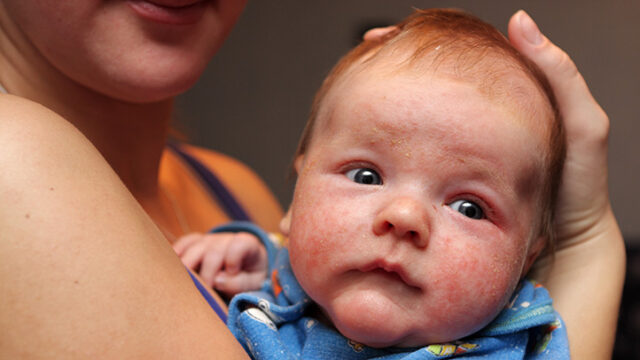
Stress During Pregnancy Can Affect the Fetus
A new series of experiments in mice shows that fetal exposure to maternal stress hormones makes mast cells hyperreactive. “Making mothers feel guilty is absolutely not the point of this research. Maybe this is more of a message for women’s partners and their support systems,” says Nicolas Gaudenzio of the Toulouse Institute for Infectious and Inflammatory Diseases in France.
Earlier studies hinted at a link between maternal stress and infant eczema. To test this, Gaudenzio’s team stressed pregnant mice in late gestation—a key period for immune and nervous system development—by placing them in narrow tubes under bright lights several times a day. Stress hormones rose sharply in both the mothers’ blood and their amniotic fluid.
When the pups were later exposed to mild skin irritants, almost all offspring of stressed mothers developed eczema-like rashes that were red, scaly, or itchy. By contrast, pups from unstressed mothers sometimes showed minor irritation, but not full-blown lesions (Nature, doi.org/g9ztb8).

RNA sequencing revealed nearly 300 genes in sensory neurons—and about 500 in skin mast cells—were expressed differently in pups from stressed pregnancies, many linked to pain, touch, and itching. Under the microscope, mast cells looked primed to release histamine.
Crucially, blocking corticosterone—the rodent stress hormone—during pregnancy prevented the effect, while giving extra corticosterone to unstressed mothers reproduced it. Pups genetically engineered to lack mast cells altogether did not develop eczema, even if their mothers had been stressed.
“It’s quite a thorough and very interesting study,” says Thomas Plum, a cellular immunologist at the German Cancer Research Center in Heidelberg. But he cautions: “It’s intriguing, but it’s just the first foot in the door”—because these results are so far limited to mice.