

Mother Not Required For Birth? Scientists Create Mice with Two Fathers, Using Embryonic Stem Cell Engineering

Scientists in China have successfully created mice with two biological fathers by manipulating embryonic stem cell technology. These mice have now survived to adulthood, marking a significant milestone in reproductive science.

There is no natural example of an animal with two fathers and no mother. Compared to an egg, mature sperm cells are highly specialized, and they can’t divide into other cells. To get around this, scientists had to create egg-like cells from male embryonic stem cells, and then fertilize those eggs using sperm from a different male. Before fertilization, imprinting genes were modified by researchers to ensure only one copy of each gene was expressed in the offspring.

This success presents a potential method for enhancing embryonic developmental capabilities. While scientists had previously created mice with two female parents two decades ago, achieving the same with two male parents has proved to be a challenge.

This is not the first time scientists have bred mice with two fathers; a Japanese research team did so in 2023 using a different method. The scientists say that if the study is improved, it could help the field of regenerative medicine, which replaces organs or tissue damaged by disease or other causes and could be helpful in future attempts to save severely endangered species.

Targeted Genetic Engineering Used

The latest success was made possible through targeted genetic engineering of imprinted genes, genes that are usually expressed from only one copy from either the mother or the father, while the other copy remains silent. A research team led by scientists from the Chinese Academy of Sciences published their research in the peer-reviewed journal Cell Stem Cell on Tuesday. “We demonstrate that correcting 20 imprinted genes enables the development of viable bi-paternal mice,” the paper stated. This is called unisexual reproduction.
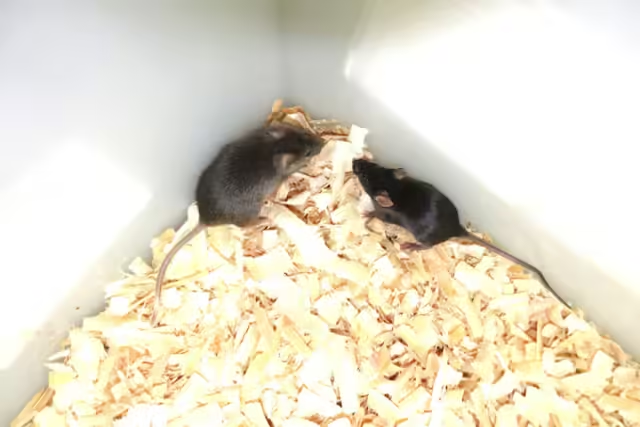
A mouse with two male parents, created by scientists in China who used embryonic stem cell engineering and cloning. Photo source: Reuters

Advancing Regenerative Medicine

Professor Luo Guanzheng, a co-author from Sun Yat-sen University in Guangzhou, highlighted the significance of the findings in a journal press release. “These results provide strong evidence that imprinting abnormalities are the primary barriers to unisexual reproduction in mammals,” Luo explained. He further stated that this approach could greatly improve developmental outcomes for embryonic stem cells and cloned animals, paving the way for more effective and advanced regenerative medicine.

Asexual Reproduction is Difficult in Mammals

While mammals are known to reproduce only through sexual reproduction, certain other animals, such as some species of lizards, can reproduce asexually, but this phenomenon has never been naturally observed in mammals. When scientists first attempted to achieve this artificially decades ago, they succeeded in creating bi-maternal embryos, but these embryos failed to survive after being implanted in the uterus. Eventually, researchers discovered that imprinted genes were the key factor responsible for this limitation.

This pioneering study not only expands the possibilities of reproductive biology but also holds promise for medical advancements in genetic engineering and regenerative therapies.


Hot this week

Rajasthan’s ” Yashoda Mothers ” Donate Breast Milk at Barmer Hospital to Save Newborn Babies

In the heart of Rajasthan, the Mother Milk Bank at Barmer District Hospital is creating a life-saving impact for newborn babies through an extraordinary act of kindness. More than 3,500 women, lovingly referred to as “Yashoda Mothers,” have donated breast milk to help infants who are unable to receive nourishment from their biological mothers. Inspired by the story of Yashoda and Lord Krishna, the initiative reflects the spirit of selfless motherhood and humanity.

मुंबई में 3 महीने के बच्चे की ब्रेन ट्यूमर सर्जरी ने बचाई जान

मुंबई में 3 महीने के बच्चे की ब्रेन ट्यूमर सर्जरी सफल रही, जिसमें डॉक्टरों ने जटिल ऑपरेशन कर जानलेवा ट्यूमर हटाया। समय पर पहचान और इलाज से शिशु को नई जिंदगी मिली, जो माता-पिता के लिए किसी चमत्कार से कम नहीं है।

Rare 3-Month-Old Baby Brain Tumour Surgery in Mumbai | Gives Infant Second Chance at Life

A 3-month-old baby brain tumour surgery in Mumbai saved an infant after doctors at Bai Jerbai Wadia Hospital for Children removed a rare, life-threatening tumour.

Infant Liver Transplant in India: 18 महीने के बच्चे को मिला नया जीवन

एक दुर्लभ और अत्यंत जटिल infant liver transplant in...

Topics

Rajasthan’s ” Yashoda Mothers ” Donate Breast Milk at Barmer Hospital to Save Newborn Babies

In the heart of Rajasthan, the Mother Milk Bank at Barmer District Hospital is creating a life-saving impact for newborn babies through an extraordinary act of kindness. More than 3,500 women, lovingly referred to as “Yashoda Mothers,” have donated breast milk to help infants who are unable to receive nourishment from their biological mothers. Inspired by the story of Yashoda and Lord Krishna, the initiative reflects the spirit of selfless motherhood and humanity.

मुंबई में 3 महीने के बच्चे की ब्रेन ट्यूमर सर्जरी ने बचाई जान

मुंबई में 3 महीने के बच्चे की ब्रेन ट्यूमर सर्जरी सफल रही, जिसमें डॉक्टरों ने जटिल ऑपरेशन कर जानलेवा ट्यूमर हटाया। समय पर पहचान और इलाज से शिशु को नई जिंदगी मिली, जो माता-पिता के लिए किसी चमत्कार से कम नहीं है।

Rare 3-Month-Old Baby Brain Tumour Surgery in Mumbai | Gives Infant Second Chance at Life

A 3-month-old baby brain tumour surgery in Mumbai saved an infant after doctors at Bai Jerbai Wadia Hospital for Children removed a rare, life-threatening tumour.

Infant Liver Transplant in India: 18 महीने के बच्चे को मिला नया जीवन

एक दुर्लभ और अत्यंत जटिल infant liver transplant in...

Rare Infant Liver Transplant Saves 18-Month-Old: Challenges, Risks, and Hope for the Future

A rare and highly complex infant liver transplant in India has given a new lease of life to an 18-month-old child suffering from a serious metabolic disorder. The procedure highlights both the medical challenges of operating on infants and the promising future such interventions can offer.

Hormonal Contraceptives May Lower Risk of Chronic Rhinosinusitis in Women, Study Finds

A comprehensive new study involving nearly 240,000 women has...

WHO Approves First Malaria Treatment for Newborns and Infants

The World Health Organization (WHO) has granted prequalification to...

Related Articles

Translate »